
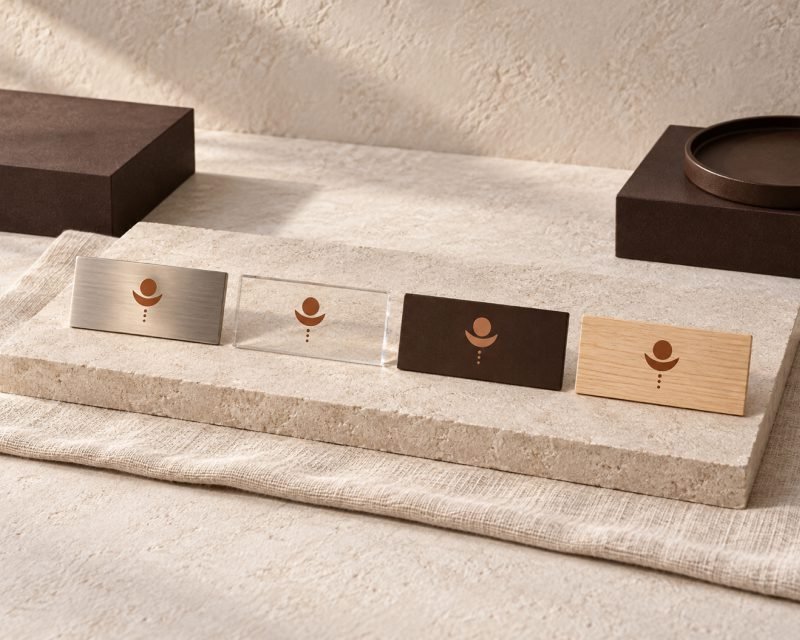
Metal Name Plates in Dubai: The One That Survives the Corridor
If a plate has to last ten years in a busy building, it is made of metal. Metal name plates in Dubai take knocks, cleaning products, sunlight and handling better than anything else we offer, and the reasons are all in the surface.
Metal Name Plates: tell us the size, the quantity and the date you need it by.
An estimator replies with a firm, VAT-inclusive price and a production date.From your file to the finished job.
Six steps happen between the brief and the finished job. Here they are, in the order they happen on our floor in Dubai South.
The Brushed Grain Hides Damage
A brushed finish has fine parallel lines across it. New scratches fall into that pattern and stop being visible, which is why a brushed plate in a corridor still looks respectable after years while a gloss one shows every mark.
Anodising Puts the Colour Inside
Anodised aluminium carries its colour in a hardened surface layer, not in a coat on top. Nothing flakes and nothing peels. Black anodised with the lettering cut through to bright metal is the most durable office plate we make.
Stainless Handles Outdoors
For gates, external walls and anywhere the plate gets wet, stainless steel is the choice. It needs a wipe occasionally in a dusty climate and otherwise looks after itself.
Etching and Engraving Behave Differently
Chemical etching gives a slightly softer character edge and suits fine detail. Laser engraving is sharper and faster. On brass and stainless we usually etch, on anodised aluminium we engrave through the surface.
It Is Heavy, Which Matters
Metal weighs enough that the fixing becomes a real decision. On plasterboard it needs a proper anchor, and on a glass partition it needs a standoff from the adjacent wall. We work the fixing out with the plate, not after it.
Over the Years
Metal plates generally outlast the layout printed on them. When a floor is rebranded, the plates are often remade in the same material and finish so the building stays consistent.
The fair criticism of metal is glare. A polished finish under a downlight or facing the sun throws light straight back and the lettering vanishes at exactly the angle somebody is reading from. Brushed or matt solves it, and we specify those by default for anything in bright light. Thickness follows the same logic. Most office plates are one and a half to two millimetres, rigid enough to stay flat on a wall. Going thicker mainly adds weight and cost without changing how it reads, so we keep the extra for reception pieces that are seen edge on.
Compare with acrylic and wooden plates, or see name plate materials.
Setting up your file.
- 01Send the logo as a vectorLetters and shapes are cut from your outlines, so we need AI, EPS, SVG or PDF, not a screenshot or a JPEG.
- 02Measure the real spaceWidth, height and a straight-on photo of the wall or fascia. The tape measure often disagrees with the drawing.
- 03Send names as textFor plates and directories, send names and titles in a document, so nothing is retyped from an image.
- 04Tell us about power and the wallFor lit signs, where the nearest power point is. For every sign, what the wall is made of.
Quick answers.
Stainless steel, comfortably.
Brushed. Polished glares under downlights.
Etched for fine detail, engraved for speed and sharpness.