
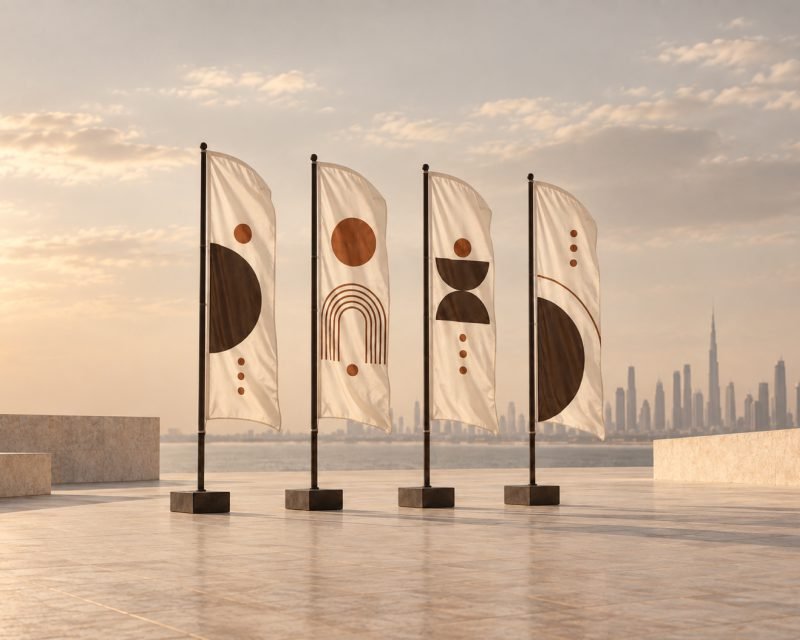
Festival Flags in Dubai: Dressing a Route, Not a Doorway
Festival flags are bought by the dozen. The job is not to mark one entrance but to turn a street, a park or a corniche into somewhere an event is clearly happening. Festival flags in Dubai are specified as a quantity and a rhythm before anybody discusses the artwork.
Festival Flags: tell us the size, the quantity and the date you need it by.
An estimator replies with a firm, VAT-inclusive price and a production date.From your file to the finished job.
Six steps happen between the brief and the finished job. Here they are, in the order they happen on our floor in Dubai South.
Spacing Sets the Effect
Flags every ten metres read as decoration. Every thirty metres they read as occasional signage. The interval is decided on site by walking the route, because it changes with the width of the space.
A Repeating Sequence Beats Variety
Two or three designs alternating along a run look intentional. A dozen different flags look like leftovers from other events. We set the repeat and keep it consistent in every direction of travel.
Height Clears the Crowd
At a busy event, anything below three metres disappears behind people. Festival work is usually taller than the same flag would be outside a showroom.
Bases Go Where Feet Go
These stand in pedestrian areas, so bases must be stable, low profile and not a trip hazard. Flat plate and water bases with covers are the usual answer.
They Come Down Fast
Most festival installations are up for days and removed overnight. Kit is specified so a small crew can lift a whole route quickly without tools.
Stored for Next Year
Annual events reuse hardware and reprint flags, so we keep the pole and base specification on file alongside the artwork. Budget usually sets the interval before aesthetics do. Where the number is fixed, concentrate the flags near entrances and junctions and let the stretches between them run bare. Think about who takes them down. A route dressed by a contractor and removed by venue staff needs hardware that comes apart without tools, because anything requiring a specific key or spanner ends up cut off and replaced.
The point worth raising early is permission. Flags in public spaces and along corniches usually need approval from the municipality or the venue, covering position, height and sometimes content. That approval takes longer than production does.
See also bunting flags, cluster flags, and flag printing.
Setting up your file.
- 01Work at full size or to scaleBuild the file at full size, or at a stated scale such as 1:10 when the canvas gets too big, and tell us the scale.
- 02Match resolution to distanceSomething read from a few metres away needs far less resolution than a business card. Around 100 dpi at full size is usually plenty.
- 03Tell us how it will be fixedHems, eyelets, pole pockets and frames take up material around the edge. Tell us the fixing and prepress allows for it.
- 04Send logos as vectorsAI, EPS, SVG or PDF keeps edges sharp at large sizes. Embed or outline the fonts.
Quick answers.
Decided by spacing. We walk it with you.
In public spaces, usually yes.
Yes, for years. Only the flags are reprinted.